
Tankless water heater service in Highland, CA means installing, repairing and flushing on-demand units, and the maintenance side matters most here. East Valley Water District reports average hardness of 152 mg/L, and hard water scales a tankless heat exchanger faster than most owners expect.
Ask whether the plumber services your brand and gives a price before work starts. If your unit shows an error code or runs lukewarm, a flush often fixes it.
Why Tankless Units Need Flushing in Hard Water
A tankless heater heats water as it flows through a narrow heat exchanger. Dissolved minerals in hard water bake onto that surface and shrink the passage. The unit then works harder, throws error codes and delivers less hot water.
A descaling flush circulates a mild acid solution through the exchanger to dissolve the scale. Most manufacturers recommend a regular schedule, and in hard water that schedule needs to be tighter. Flush calls are the most common reason homeowners phone about tankless units.
Signs Your Tankless Unit Needs Service
These point to scale, a failing part or a supply issue.
- Error codesOften flow, ignition or temperature faults tied to scale.
- Lukewarm waterThe unit cannot keep up with demand.
- Fluctuating temperatureSensors are reading scale, or flow is below the minimum.
- Noisy operationRestricted flow through the heat exchanger.
- Rising gas billsThe unit runs longer to heat the same water.
- No hot water at allCheck the power, gas valve and error display before calling.
Error Code on the Display?
Note the code and call (909) 505-3225. A plumber can often tell you the cause over the phone.
Call (909) 505-3225Flush and Descale: What the Visit Includes
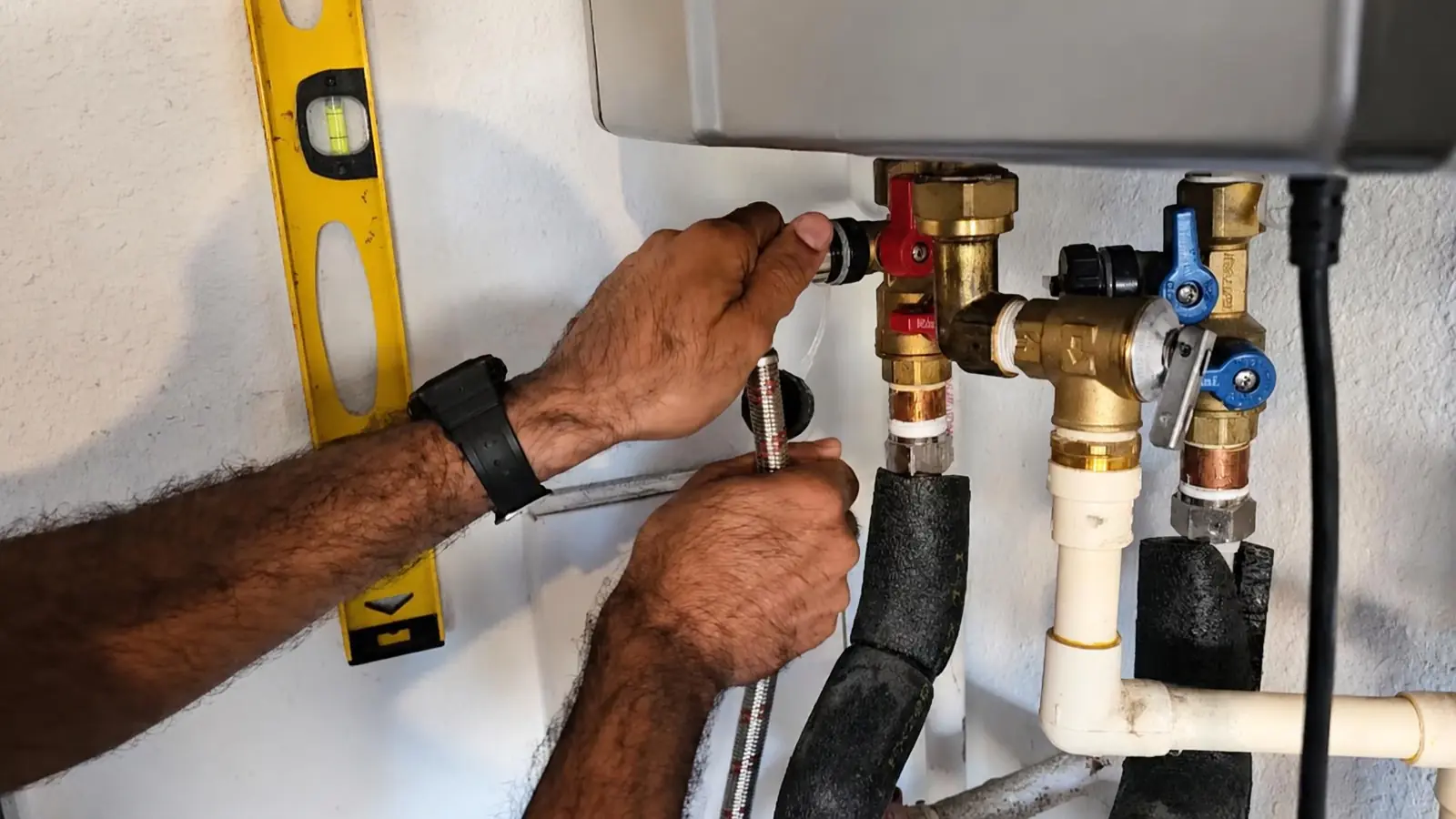
We isolate the unit with its service valves, connect a pump and bucket, and circulate descaling solution through the exchanger. We then rinse, clear the inlet screen and check the flame and flow readings.
The service takes a short visit, and we recommend a schedule based on your water. In Highland that usually means more often than the manufacturer's baseline. If your home has no isolation valves, we add them so the next flush is simpler.
Tank Versus Tankless for a Highland Home
The right choice depends on demand, space and water quality.
| Factor | Tank heater | Tankless heater |
|---|---|---|
| Hot water supply | Limited by tank size | Continuous within flow rating. |
| Hard water effect | Sediment on tank floor | Scale on heat exchanger. |
| Maintenance | Annual flush | Descaling flush on a schedule. |
| Space | Needs floor area | Wall-mounted. |
| Install complexity | Usually simpler | May need larger gas line or vent. |
A Hard Water Reading That Changes the Math
The East Valley Water District report puts Highland's average hardness at 152 mg/L, roughly 8.9 grains per gallon by the standard conversion. Water at that level is firmly in the hard range, so scale management should be part of any tankless plan from day one.
A water softener ahead of the heater reduces scale at the source. A homeowner who does not want a softener can follow a descaling schedule instead. We help you pick based on how long you plan to stay in the home.
Tankless units follow the manufacturer's venting and gas sizing standards, and their electrical connections follow the National Electrical Code (NEC) as adopted in California.
Installing a Tankless Heater
A tankless install touches gas, venting, water and often electrical, so the sequence matters.
Check capacity
We confirm gas line size, vent route and electrical supply.
Plan the connections
Isolation valves, a relief valve and a condensate path are set before the unit goes up.
Mount and connect
The unit is mounted, vented and connected to water and gas or power.
Commission
We test flow, temperature and combustion and walk you through the controls.
What Affects Tankless Service Pricing
Flush calls and installs are priced differently.
Rebates for efficient heaters change, so check with your utility before buying.
For a price on your unit, call (909) 505-3225.
Frequently Asked Questions
Follow the manufacturer's schedule as a baseline and expect to shorten it in hard water. Highland's reported average hardness is 152 mg/L, so many owners flush more often than once a year.
Yes. Many codes point to scale or flow problems, which a flush may clear. Others need a part. Give us the code and model when you call.
It reduces scale at the source and can extend service intervals. Our water softener and filtration page explains the trade-offs.
Often yes. We check gas line size, venting and electrical supply first, then quote the conversion. See also water heater installation.
It can be, especially if space is limited. Savings depend on usage, and the real return comes from fewer standby losses and longer equipment life when maintained.
Yes. We cover Redlands along with Highland, San Bernardino and Mentone.