
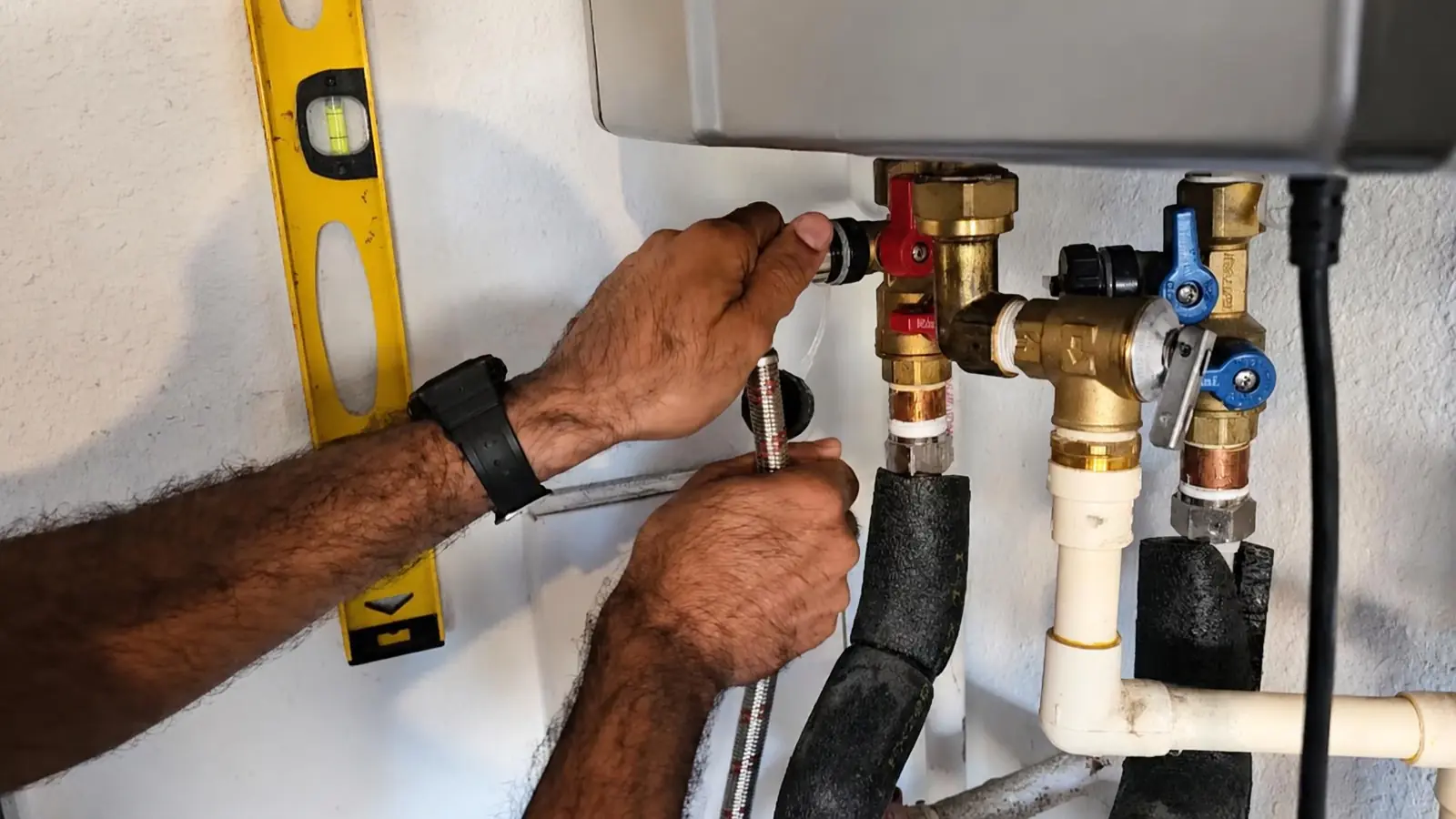
A tankless water heater flow sensor measures how much water is moving through the unit, and the heater fires only when it detects enough flow. If the sensor is dirty, scaled or failing, the unit may run cold, cycle on and off or show an error code. Cleaning or replacing the sensor often restores normal operation.
Because tankless units involve gas, venting and electrical parts, most repairs belong to a licensed plumber. Call to ask about service timing in Highland.
How the Flow Sensor Works
The sensor sits on the cold inlet. When you open a hot tap, water spins a small turbine or presses a sensor, and the controller reads the flow. If the flow is high enough, the burner lights.
Scale can jam the turbine or coat the sensor face, and then the unit sees low flow when there is plenty. The heater may refuse to fire, or it may fire and then shut off after a few seconds.
Signs of a Flow Sensor Problem
These symptoms often trace back to the sensor.
- Cold water at the tap with the heater onThe unit does not detect flow.
- Hot water that cuts out mid showerThe sensor loses the signal.
- The unit runs only at high flowA dirty sensor misreads low flow.
- An error code for flow or waterThe controller flags the sensor.
- Fluctuating temperatureThe sensor reads inconsistent flow.
Heater Running Cold?
Call (909) 505-3225 and a plumber can diagnose the sensor and the rest of the unit.
Call (909) 505-3225Common Tankless Faults
Not every symptom is the sensor, so a technician checks several parts.
| Symptom | Likely cause | Typical fix |
|---|---|---|
| Cold water, no ignition | Flow sensor, inlet filter | Clean or replace. |
| Error code with ignition | Gas supply, vent, flame sensor | Check supply and clean. |
| Temperature swings | Scale, sensor or mixing | Descale and test. |
| Low hot water volume | Scale in the heat exchanger | Flush with descaler. |
Why Scale Matters So Much
Scale builds fastest where water is hot. A tankless heat exchanger is small and runs hot, so it collects scale quickly in hard water areas. Manufacturers call for regular descaling, and skipping it can damage the sensor and the exchanger.
A flush with a descaling solution removes buildup. Our tankless water heater page explains service and installation, and our water softener page covers reducing scale at the source.
Highland Water and Tankless Units
East Valley Water District's 2026 Consumer Confidence Report lists average hardness at 152 mg/L, and about 78 percent of its supply came from Bunker Hill Basin groundwater. Hard groundwater is the kind that builds scale in a tankless exchanger. A yearly flush is a sensible schedule here, and your manual may call for more.
The City of Highland's April 2017 Water Heater Installation Bulletin covers installation items such as venting and combustion air. Venting matters for tankless units too, so ask a plumber to check it when the unit is serviced.
Tankless heaters are installed to the manufacturer's standards for flow, venting and gas supply, and their power connections follow the National Electrical Code (NEC) as adopted in California.
What a Descaling Service Includes
Your technician follows a sequence that protects the unit.
Isolate water and gas
Service valves are closed and the unit is shut off.
Connect a pump and descaling solution
Hoses connect to the service ports.
Circulate the solution
It dissolves scale in the heat exchanger and the sensor.
Flush and clean the filter
Clean water rinses the unit and the inlet screen is cleaned.
Restart and test
We confirm flow, ignition and temperature.
A Maintenance Habit That Pays Off
Write the date of each flush on the unit or in your phone. A yearly flush costs less than a new heat exchanger, and the sensor stays clean and responsive.
If your household uses a lot of hot water, or your water is very hard, ask about a softener upstream of the heater. It reduces scale at the source and protects the whole system.
Minimum Flow and Low Flow Fixtures
Tankless units need a minimum flow to fire. A low flow shower head or an aerator can drop flow below that line. If the heater works with a full flow tap but not at a low flow one, the problem may be the fixture and not the sensor.
A plumber can measure flow at each fixture and tell you whether a cleaning, a sensor or a fixture change will fix it.
Warning Signs to Never Ignore
Tankless units burn gas and vent combustion gases. A yellow flame, a soot stain around the vent, a gas smell or a carbon monoxide alarm are not sensor problems. Turn the unit off, ventilate and call a plumber or the gas utility from outside.
Treat any error code you do not understand as a prompt to read the manual or call. A unit that shuts itself off is doing its job, and a repair that restores the shutdown without addressing the cause is not safe.
What to do if the heater shuts off or smells of gas
Safety comes before repair.
- Leave the area if you smell gasCall the gas utility from outside.
- Do not relight repeatedlyRepeated ignition attempts can build up gas.
- Turn the unit offUse the power switch and the gas valve.
- Check a carbon monoxide alarmReplace its batteries each year.
- Call a plumberVenting and flame faults need a technician.
Repair, Descale or Replace
A descale and a sensor cleaning cost much less than a new unit, and they solve many cases. A failed sensor is a small part, and replacement is common. A cracked heat exchanger or a repeated fault in an old unit may justify replacement.
We serve Redlands, San Bernardino and Mentone as well as Highland.
Frequently Asked Questions
Some owners can remove the inlet filter, but sensor work involves isolating water, gas and power, so a plumber is safer.
Follow the manufacturer's schedule. Hard water areas often need yearly service.
The burner lights only when the sensor detects enough flow. Low flow fixtures may not trigger it.
East Valley Water District reports average hardness of 152 mg/L in 2026, which is hard water.
Yes. See Redlands.